From Cold Cream to the Modern Beauty Counter
Cold cream’s changing role shows how beauty retail turned one familiar staple into distinct cleansing and moisturizing choices for different routines.
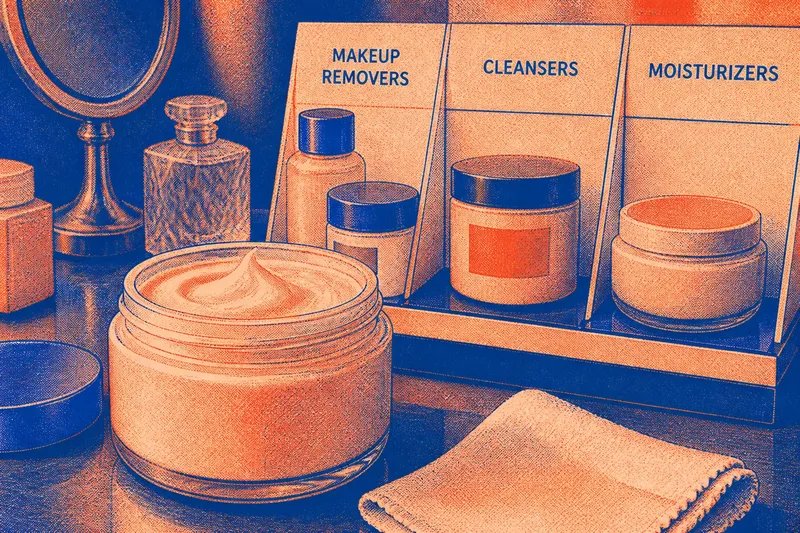
Why did cold cream once stand for more than removing makeup? Cold cream’s history offers a small, tangible way to see how beauty retail gives familiar products new meanings—not only through formulas, but through labels, displays, and the jobs assigned to them.
Cold cream is a rich cream traditionally associated with oils, waxes, and water, though formulas vary. Its name refers to the cooling sensation some people notice as water evaporates from the skin. Rather than treating one recipe or one use as universal, it helps to look at cold cream as a product category whose meanings have shifted across homes and shops.
Cold cream’s household life
Cold cream became known as a multipurpose personal-care staple: a jar that could sit on a dressing table and serve more than one role. It was commonly associated with loosening makeup and with softening dry-feeling skin. That broad reputation made the product useful as an everyday object, not just as a specialized item with a single task.
Its place in household routines also carried a cultural message. A familiar jar could stand for self-care that was practical and tactile: open it, smooth on the cream, and use it in a way that suited the moment. The product’s identity came partly from its texture and container, and partly from the habits people built around it.
Retail’s changing vocabulary
As beauty retail expanded its displays and product lines, shoppers increasingly encountered named categories such as cleanser, moisturizer, and makeup remover. This is best understood as a gradual change in retail language, not a single moment when one kind of product replaced another. Stores could group and describe products by their intended jobs, making those distinctions more visible to customers.
Packaging, shelf placement, and sales conversations helped communicate those jobs. A cream displayed with makeup removers might be understood chiefly as a cleansing product, while one placed among richer creams might suggest a leave-on role. Those signals shaped expectations, even though placement alone could not establish what a particular formula was intended to do.
The shift was cultural as much as practical: product names began to sort everyday care into more clearly labeled tasks. A broad, familiar category like cold cream could sit alongside specialist terms without becoming obsolete. Retail language offered shoppers a map, but it also encouraged them to imagine a routine as a set of separate choices.
One jar, different meanings
Cold cream’s reputation did not settle into just one role everywhere. People might associate it with makeup removal, skin comfort, or both. Labels and directions matter for a particular product, but the wider cultural story is about how a shared product type could carry several meanings at once.
Imagine a shopper whose family has long kept a jar of cold cream on the dressing table, where it is used to loosen face powder and soften dry-feeling skin. At a department-store counter, she sees a similar jar grouped with makeup removers and a separate cream placed with leave-on products. She reads the labels, keeps the familiar jar for the use its directions support, and decides the second product is unnecessary for her routine. The visible result is a clearer interpretation of the display, not an obligation to own both products.
What does the counter suggest?
Why did cold cream become a household staple?
Its multipurpose reputation made it easy to associate with several familiar personal-care habits. The jar and rich texture also helped give it a recognizable place in domestic beauty culture.
Did retail categories replace cold cream?
Not in a simple, universal handoff. More specialized labels made particular jobs easier to identify, while cold cream continued to carry familiar associations for many shoppers.
How do displays shape a product’s meaning?
Shelf placement and packaging can foreground one intended role over another. They are clues about how a retailer presents an item, not substitutes for reading its directions.
What is not worth the effort?
It is not useful to treat every category on a shelf as a separate requirement for a complete routine. A label can help describe a product without creating a new need.
Reading beauty categories
A beauty counter is also a language system. Categories help shoppers scan a display and connect products with tasks, but they can make flexible staples seem narrower than the uses people associate with them. Cold cream’s changing retail identity shows how a product can retain its cultural familiarity while its place in a shop shifts.
When a display feels persuasive, separate what it tells you from what it asks you to buy. Notice whether the wording describes a product type, a texture, or an intended job. Then let the actual label and directions—not the neighboring products—guide decisions about use.
For anyone curious about cold cream’s place in beauty culture, the most revealing detail may be the ordinary jar itself: an object that moved between household habit and retail category. Reading that shift can make a crowded counter easier to interpret, while leaving room for personal routines that do not follow the shelf’s divisions.