The More Steps, the Better Routine Myth
A simpler personal care routine can be easier to use and assess. Learn how to review each step, keep the ones you value, and let the rest go.
How do you know whether a personal care routine is helping—or just taking up more of your morning? A longer routine is not automatically a better one. The useful question is whether each step has a purpose you care about, fits your day, and feels comfortable enough to keep doing.
That does not mean everyone needs the same short routine. Someone may enjoy a leisurely sequence of skincare and makeup; someone else may want to wash, moisturize, and leave. The point is not to reach a smallest-possible number of products. It is to choose deliberately, rather than treating each new step as an upgrade.
Personal care routine review
A routine can grow by accumulation. A product catches your attention, a friend mentions a favorite, or a video presents several steps as a complete set. Soon, getting ready involves products you cannot explain, items you use only when you remember, and a few you like for the sensory experience. Those are different reasons to keep something, and it helps to name them.
Try treating one week as an observation period, not a makeover. Keep using your familiar products and notice what each step contributes. Does it help with a concern you have? Is it pleasant? Does it make getting ready feel more manageable—or does it add a task you resent? A product can earn its place through enjoyment, not just visible change.
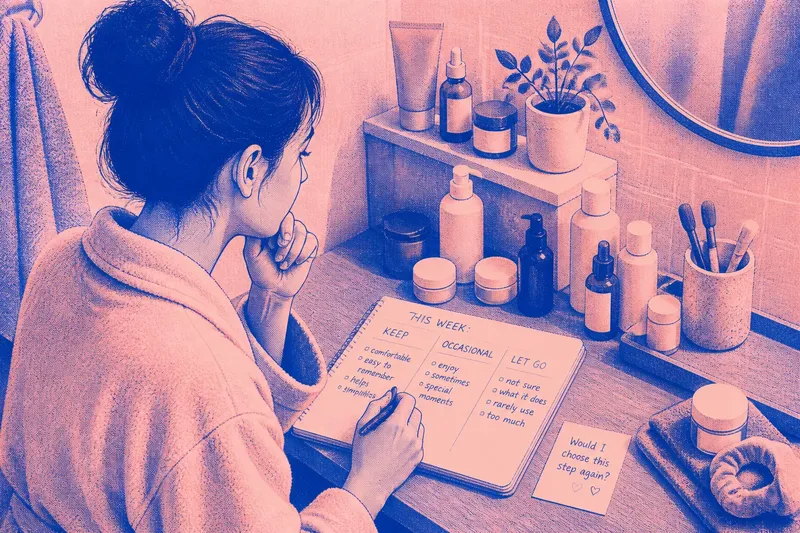
Write a short note on your phone or a scrap of paper. Use plain words such as “comfortable,” “easy to remember,” “feels like too much,” or “not sure what this does.” You do not need to track every detail or judge your appearance. The aim is to notice your experience without turning self-care into another performance.
A week of noticing
Use this gentle schedule to make a decision without changing everything at once. If a product causes discomfort or you have a health concern, pause and seek appropriate professional advice rather than continuing just to complete the review.
- Days one and two: Follow your ordinary routine. Note the steps you naturally reach for and any that feel like an interruption.
- Day three: For each item, finish the sentence, “I keep this because…” A clear answer might be “it makes my skin feel comfortable” or “I like the color.” “I’m supposed to” is a reason to reconsider, not a reason you must keep it.
- Day four: Notice the time and setting. A step that works calmly on a weekend may be awkward before an early commute. You can value it and still decide it belongs in a different version of your routine.
- Day five: Leave out one nonessential step that you are unsure about, while keeping the rest familiar. Notice whether you miss it, feel relieved, or simply do not think about it.
- Day six: If you want, bring the step back and notice whether you prefer the routine with it. This is a preference check, not a contest between “good” and “bad” skin or appearance.
- Day seven: Choose a place for the item: keep it in the regular routine, save it for occasions when you enjoy it, or stop using it. You do not have to make a permanent decision about every product that day.
Say you have a face mist beside your moisturizer because it came in a set. During the week, you notice that you like its cool feel after a shower but never reach for it before work. You might keep it for unhurried evenings instead of treating it as a required daily step. That is a useful decision even if nothing about your appearance changes.
Give steps clear jobs
It can help to sort steps by the job they do for you. Some support basic comfort or cleanliness; some address a particular personal care concern; others are optional pleasures or ways to express your style. These groups overlap. A scented lotion might be practical for one person and mostly enjoyable for another.
Look for duplication in your actual experience, not on a theoretical ideal routine. If two products feel similar to use and you do not particularly value having both, one may be enough for your preferences. If you enjoy alternating them, that can be reason enough to keep both. The question is not whether two items could serve similar purposes in general, but whether you want both in your life.
Order matters chiefly when product directions specify it or when a particular combination is not suitable for you. For everyday planning, you can also arrange steps around ease: put frequently used items where you get ready, and keep occasional products separate so they do not make the ordinary routine feel crowded. Follow the product label and manufacturer instructions, and check local guidance where relevant.
Questions about routine length?
Do I need a morning and evening routine?
Not necessarily. Your schedule, preferences, and personal care needs can make one routine simpler or more appealing than two. Choose a pattern you can live with rather than copying someone else’s daily schedule.
Should I stop several products at once?
If you are only reviewing what you enjoy, changing one uncertain step at a time can make your preferences easier to notice. If a product is irritating you or you have a health concern, stop using it and consult a qualified professional when appropriate.
What if I like having many steps?
Keep them if they suit you and feel worth the time, space, and expense for your circumstances. A longer routine is not a problem simply because it is longer.
What if I am unsure what a product is for?
Check its label and the manufacturer’s directions, then consider whether its stated purpose connects to something you want from your routine. If the description still leaves you uncertain, you do not have to use the item just because you already own it.
Make room for changing days
A routine does not have to be identical every day to count as a routine. You might prefer a short version before work and a more involved one when you have time. You can also keep certain products for a specific occasion, weather change, or mood, as long as that choice suits your needs. Flexibility can make a routine feel more personal than following a fixed sequence without asking why.
What is not worth the effort? Trying to make every product fit an elaborate scoring system, or keeping a complicated log when a few honest notes will do. If reflection starts to feel like homework, return to one simple question: “Would I choose this step again?” Your answer can be practical, emotional, or both.
The best personal care routine is not a product count or a standard to match. It is a set of choices you can explain to yourself, including the choice to enjoy an optional step—or to leave it out. Revisit your choices when your schedule, preferences, or needs change, and let the routine change with them.